Ecological Restoration
&
Climate-Resilient
Community Food Security

The many benefits of bison restoration
______________________________________________________________________
Biodiversity Enhancement
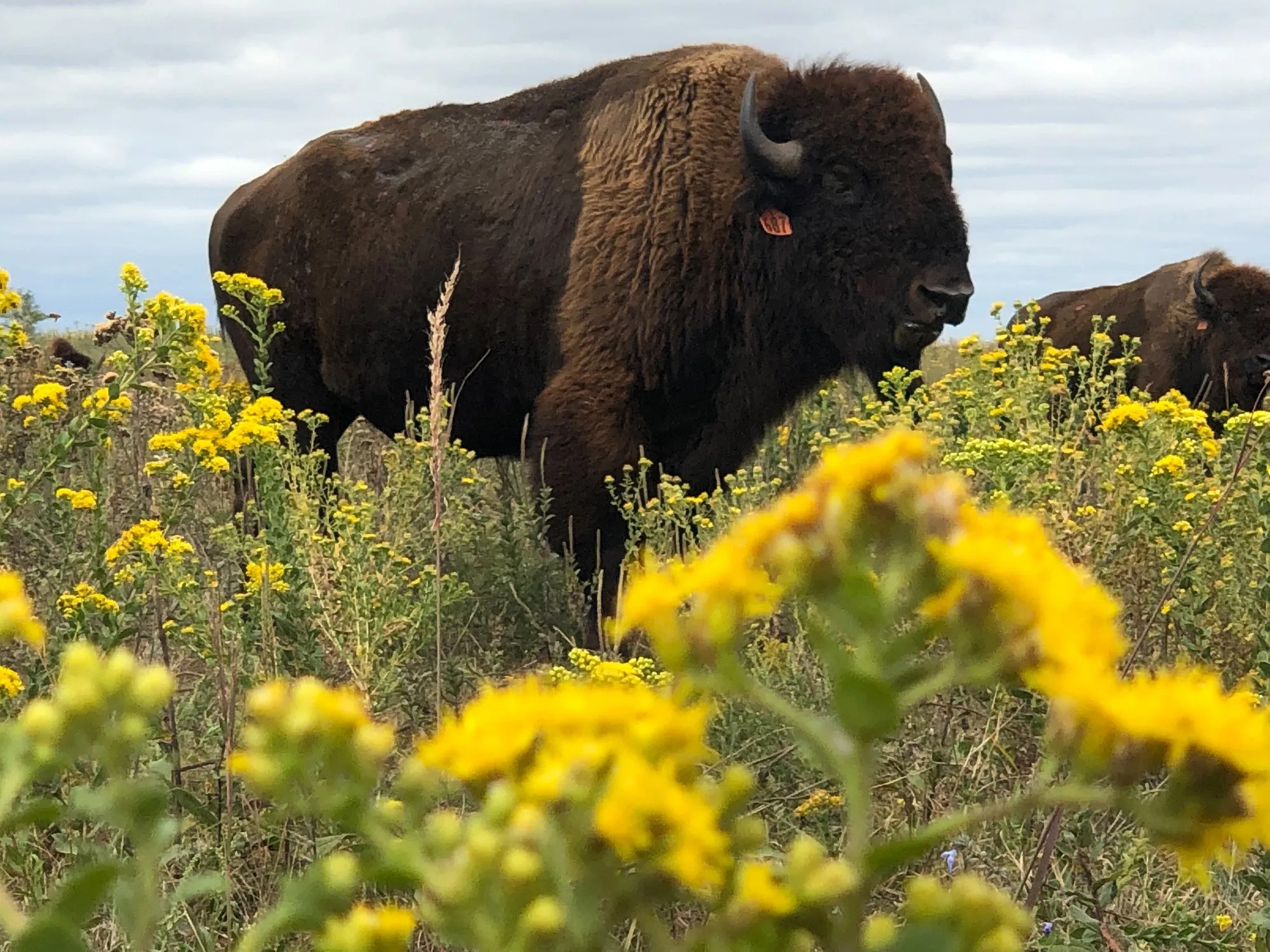
It is well documented across long-term research studies that bison offer far superior restoration outcomes than even the most regeneratively ranched cattle, because they have co-evolved with a significant number of ecosystems across North America, and they are a keystone species in many ecosystems (Kansas State University, 2022). Cattle are actually a fairly poor surrogate for bison. Bison are able to make more efficient use of lower quality forage than cattle, require less water, can live in more extreme winter and summer weather, have symbiotic relationships with endangered prairie dogs and many other endangered grassland species, restore the functioning of cattle-degraded waterways by trampling eroded cut banks, remove deep snow from winter grazing areas which makes forage more accessible to other wild herbivores, till the earth with their hooves rather than compacting it, preferentially graze grasses over forb species, move more quickly across a landscape with a more beneficial impact on it, and because of their unique wallowing behavior create vernal pools which benefit a variety of plants, reptiles, amphibians, birds, and insects, and help retain surface water longer and rehydrate landscapes.
Several significant differences of biology and behavioral ecology account for the fact that bison leave in their wake a cascade of benefits to the ecosystems of the West, while cattle leave in their wake aridification and biotic impoverishment. In New Mexico in particular, juniper encroachment onto shortgrass and mixed-grass prairie ecosystems is an outcome of historic bison removal and government-subsidized overgrazing by cattle, which has dramatically desertified this landscape over the past century and a half. While junipers encroaching onto grasslands historically would be kept in check by bison rubbing against them (a study at the Rio Mora National Wildlife Refuge found that bison killed 91 per 100 juniper trees, compared to 8 per 100 on neighboring cattle ranches), in the absence of bison the junipers are able to outcompete deep-rooted perennial native grasses.
Want to read more? Chew on these studies:
- Reintroducing bison results in long-running and resilient increases in grassland diversity https://www.pnas.org/doi/10.1073/pnas.2210433119
- Bison outperform cattle at restoring their home on the range https://pmc.ncbi.nlm.nih.gov/articles/PMC9546598/
Community Food Security
The New Mexico Bison Restoration Network proposes to address challenges to regional food security and inequities in access to high-quality local food by pioneering a non-profit model of providing inexpensive meat shares to local consumers. By employing a cooperative rather than a profit-driven model, utilizing public land and native forage, and localizing animal processing, this project aims to produce meat shares as inexpensively as possible, which is extremely important as food prices skyrocket globally, and regional and global supply chains become increasingly precarious as climatic shifts impact grassland health and grain production worldwide. It is now well understood within the scientific community that a significant amount of land worldwide which has been converted to agriculture and which currently is used to feed the world must be returned to its original ecosystem function, yet there are very few models in existence for how to do so. The NMBRN aims to provide a model for North America which replaces unsustainable cattle ranching with a system that both provides meat locally within a historically poor and underserved state—although also one with a historically resourceful subsistence economy—and returns a variety of ecosystems to a more intact native state with enhanced function, fertility, and resilience. Although this project needs start-up funding and funding for the necessary scientific research to substantiate its ecological benefits, the potential is there for this to become a viably self-sustaining economic model, and a foundational cooperative of herd managers, researchers, and food industry partners which could also fund the start-up costs of further sister bison restoration cooperatives.
Read more about our work to trial virtual fencing on bison, which if successful, could make possible the widespread reintroduction of bison to our public lands (replacing for-profit, publicly-subsidized, private cattle ranching on our public lands) under Research.
Carbon Sequestration
It is well documented that grasslands are able to permanently sequester significantly more carbon than forests, and contribute more to soil fertility and biological activity when rotationally grazed. Because of increased drought and wildfire risk worldwide, grasslands are increasingly more reliable and resilient carbon sinks than forests, and are likely to replace many presently forested areas under novel climatic regimes. Restoring native ungulates to native grasslands therefore represents the most cost-effective and viable opportunity globally to sequester carbon, safeguard biodiversity, and restore imperiled ecosystem function.
There is growing interest among producers and land managers in participating in the global economy for carbon credits. There is potential merit to this concept, and it can also facilitate the greenwashing of polluting industries. Could carbon credits provide an interim funding source for struggling producers and indebted global south countries with intact ecosystems while the world transitions off of fossil fuels and perpetual-growth capitalism?
Learn more about the potential and the pitfalls of carbon credits from this sampling of opinions:
Rural Resilience & Prosperity
The current paradigm which allows ranchers to lease public land on which to graze cattle is both ecologically destructive—particularly in the brittle arid rangelands of New Mexico—and prioritizes private profit over public benefit.
Although very promising, there has not yet been enough study of the economic benefit of virtual fencing for cattle, which is the aspect of the technology that most interests ranchers. The economic benefit would be even more significant for bison ranching, considering that the prohibitive cost of bison fencing is the main obstacle that ranchers cite in choosing bison over cattle. The NMBRN proposes to trial what promises to be the most cost-effective way to reintroduce bison yet possible, by leasing a combination of state, federal, and private land, absorbing excess bison from federal herds that are continually successful enough to be outpacing the carrying capacity of their ranges, and by employing virtual fencing without the need for perimeter fencing. Our public lands should provide public benefit, and yet they are only ever decreasing in their ecological and human-use value by allowing cattle to freely range and openly graze across them, competing with native ungulates for limited forage, degrading waterways, compacting fragile soils, and altering the native ecological balance. In addition to the other benefits to native ecosystems and regional food security, bison reintroduction in New Mexico can also provide novel educational, scientific, and touristic value, and build bridges of collaboration with indigenous communities.
REWILDING
is about restoring the web of life from cities to the wildest places on the planet, by taking the long-term view, and embracing natural solutions to environmental, social, and economic challenges.

 The New Mexico Bison Restoration Network